
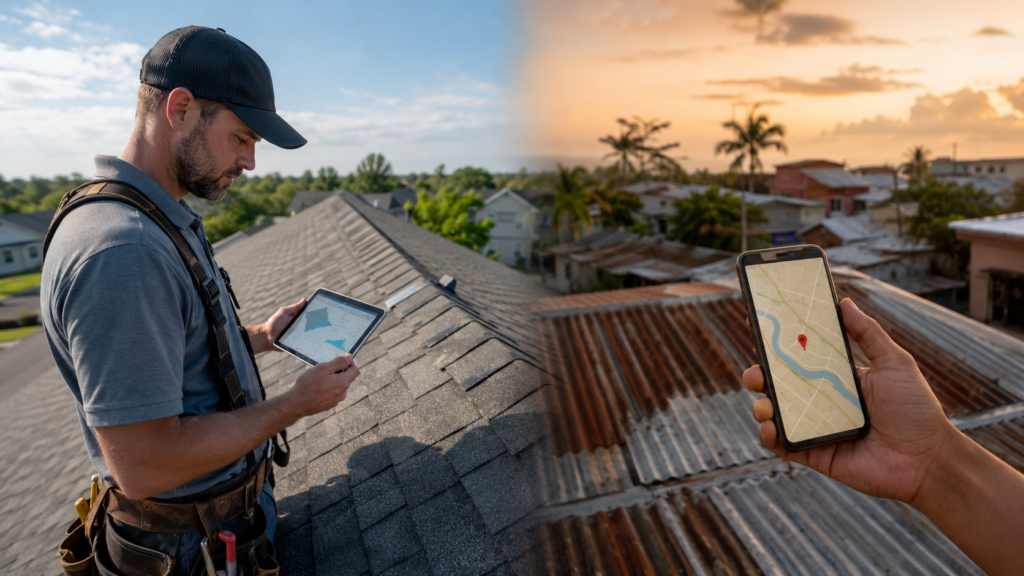
I’ve been doing SEO since 2008. In that time I’ve watched keyword lists go from “stuff enough exact-match phrases on a page” to something a lot closer to building a trustworthy, well-documented business that Google and, increasingly, ChatGPT and Perplexity are comfortable recommending. Roofing is one of the verticals I know best. My agency works with home service brands in both the US and the Philippines, and the honest answer to “what keywords should a roofer target” is: keywords are the smallest part of the job now. Let me walk you through what’s actually working in both markets this year, and what I’d tell a roofing client on day one.
The market backdrop, updated for 2026
The US roofing market is now estimated around $31 billion, growing at roughly 6% a year, with a bit over 101,000 registered roofing companies competing for attention. Roof-related insurance claims alone topped $31 billion in 2024, which tells you how much of this industry’s demand is driven by storm damage and emergencies, not just aging roofs.
The Philippines side of the market is smaller in absolute dollars but the growth curve is steeper, and digital adoption has caught up fast. Facebook and Google are now the default discovery channels for homeowners here too, especially in Metro Manila, Cebu, and Davao. The gap between “digitally mature US market” and “underdeveloped Philippine market” that used to define this comparison has narrowed a lot since 2019. What hasn’t changed is the competition gap: a Philippine roofing contractor with a decent Google Business Profile and a handful of real reviews can still out-rank competitors with almost no effort, because most of the field still hasn’t set one up properly.
The map pack is the game now, not the blue links
If there’s one thing I’d want every roofing contractor to understand before we talk about keywords, it’s this: the Google Map Pack now shows up in roughly 93% of local searches and pulls in about 44% of all clicks on those results. Depending on the study, somewhere between 60% and 90% of roofing leads originate from that map pack, not from a standard organic listing. Over 70% of those searches happen on a phone, often while someone is standing under an active leak.
That changes the whole priority order. Whitespark’s ranking factor research (still the gold standard I refer clients to) attributes about 32% of local pack rankings to Google Business Profile signals, another 16 to 20% to review signals, roughly 19% to on-page factors, and 11 to 13% to backlinks. In plain terms: your GBP and your reviews now outweigh your blog content for winning the map pack. I still see agencies pitch roofers a content calendar before they’ve even claimed and fully built out their profile. That’s backwards.
A complete, well-categorized GBP with real photos, correct service areas, and Q&A filled in gets roughly 7x more clicks than a half-finished one, and contractors with optimized profiles report up to 63% more leads with meaningfully higher conversion rates. If you do nothing else this quarter, fix your profile first.
Keyword strategy: still relevant, just not sufficient on its own
The bones of the original keyword list still hold up. These are the categories I’d still build a roofing site around:
Emergency and urgent intent
- emergency roof repair
- 24 hour roof repair near me
- roof leak repair today
- storm damage roof inspection
Local intent
- roofer in [city]
- roofing company near me
- roof repair [neighborhood/city]
Service and material specific
- roof replacement cost [city]
- metal roofing installation
- flat roof repair
- roof inspection before buying a house
What’s changed is the shape of the traffic behind these. Over half of roofing organic traffic today comes from long-tail and conversational queries that never show up in Ahrefs or Semrush volume data, because they’re one-off questions people type or speak once. “Why is my roof leaking after a light rain even though it’s only two years old” is a real query pattern now, and it’s not one you’ll find in a keyword planner. That’s a direct result of how people search with voice assistants and AI chat tools instead of typing three-word phrases into a search box.
Practically, this means your content needs to answer specific homeowner questions in full sentences, not just target a phrase. I build FAQ sections around actual questions customers have asked our clients on the phone, not questions I invented to hit a keyword.
US market: sophisticated, expensive, and still worth it
US roofing lead costs vary a lot by channel. Google Search Ads currently average around $228 per lead nationally, ranging from $80 to $350 depending on market and season. Local Services Ads tend to run cheaper, somewhere in the $75 to $150 range per verified lead. A mature organic SEO program, one that’s been running 12 to 18 months, typically brings that cost down to $10 to $50 per lead. That gap is the entire business case for investing in SEO rather than just running ads indefinitely.
Organic search now accounts for 38% to 54% of total inbound leads for roofing contractors with an established SEO program of a year or more. That’s a meaningful chunk of the funnel that isn’t being paid for on a per-click basis.
For content and authority building in the US market, I’m still recommending:
- Insurance and claims-focused content (storm damage documentation, what adjusters look for)
- Location-specific service area pages for every city or ZIP you actually serve, not a single generic “service area” page
- Real project galleries with before/after photos tied to a city name
- Genuine review generation systems, not review gating, which Google penalizes
One thing I’d flag honestly: nearly 70% of roofing contractors report being unhappy with their current SEO providers, and close to 80% aren’t using any AI tools at all in their marketing yet. That’s a wide-open gap. If your agency isn’t showing you monthly ranking data, lead attribution, and GBP performance, that’s worth a hard conversation.
Philippines market: still an early-mover’s game, but the window is closing
I say this from direct experience running an agency here. Philippine roofing and construction contractors who invest in even basic local SEO right now are competing against very little. Most competitors still don’t have a claimed, optimized Google Business Profile. Most don’t have a mobile-friendly site. Most have zero structured reviews strategy.
The playbook I run for local Philippine clients:
- Full GBP setup with accurate service categories, photos of actual completed jobs, and consistent posting
- Facebook Business Page as a genuine secondary channel, not an afterthought, since a large share of local discovery here still happens on Facebook and Messenger
- Content built around real regional pain points: typhoon-proofing, monsoon leak prevention, galvanized iron versus concrete roofing costs
- Simple, fast, mobile-first websites. Most homeowner searches here are on a phone with an average connection, so page speed matters more than fancy design
Cost to compete here is dramatically lower than in the US, often a fraction of what a single month of US paid ads would cost, and time to rank is usually faster because there’s less competitive noise. But that window is narrowing every year as more contractors here catch on to digital marketing. I’d rather get a client in now than in two years when the local pack is as crowded as it is in the US.
The part nobody had to think about in 2019: AI search
This is the biggest real shift since the original version of this article. Traditional search volume is projected to decline as more queries get answered directly inside ChatGPT, Gemini, Google’s AI Overviews, and Perplexity instead of a list of blue links. For a roofer, that means a homeowner might ask “who’s a reliable roofer in [city] for storm damage” directly to an AI assistant and never see a search results page at all.
Getting cited inside those answers, often called Generative Engine Optimization or Answer Engine Optimization, builds directly on top of solid local SEO but adds a few extra requirements:
- Structured, direct answers. AI tools favor content that states the answer plainly in the first sentence or two of a section, not content that builds up to it. Bury the answer under three paragraphs of backstory and the AI just skips your page.
- A real FAQ section. Four to six natural-language questions with two to four sentence answers is currently one of the highest-return additions you can make to a service page for AI citability.
- Schema markup. LocalBusiness, FAQPage, and Article schema give these tools a clean, machine-readable version of who you are and what you do. If your site’s important content only loads through JavaScript, some AI crawlers won’t see it at all, which is a real technical risk worth auditing.
- Specific expertise signals. Phrases like “in 15 years of roof inspections” or “after replacing over 400 roofs in this county” give the model something concrete to attribute a claim to. Vague marketing language doesn’t.
- Being cited by other cited sources. Getting listed in the roundups, directories, and comparison pages that AI tools already pull from adds a compounding trust signal on top of your own site’s content.
I’ll be straightforward: this space is still early and inconsistent. Research suggests roughly 80% of sources AI platforms cite don’t even appear in Google’s traditional top 10 for the same query, which tells you this is genuinely a separate discovery channel, not just a rebrand of ranking well on Google. I’m treating it the way I treated mobile-first indexing a decade ago: get the fundamentals in early, because it only gets more expensive to catch up later.
Ask Maps: the newest layer, and why your services list can’t stay generic
There’s a specific update I want every roofing client to understand, because most local businesses still haven’t caught up to it. In March 2026, Google rolled out Ask Maps, a Gemini-powered conversational feature built directly into Google Maps. Instead of typing “roofer near me” and scanning a list, a homeowner can now ask something like “find a roofer who can do an emergency tarp job tonight” or “who does metal roof replacements and has evening availability this week” and get a synthesized answer with a curated map, not a results page.
Google also quietly retired the old GBP Q&A section around the same time. Ask Maps effectively replaced it. Instead of a stored thread where a business owner or a random user answers a question once, Gemini now generates a fresh answer in real time by reading straight from your profile: your service categories, your listed services and their descriptions, your attributes, your photos, your hours, and the actual language in your reviews.
Here’s why this matters more for roofing than almost any other trade: the questions Ask Maps is built to handle are exactly the multi-condition, urgent, specific questions homeowners ask about roofers. “24-hour roofer who does storm damage tarping right now” is a textbook Ask Maps query. It’s checking multiple things at once: is this a roofer, do they offer emergency service, are they open right now, do reviews mention storm or tarp work. If any one of those data points is missing from your profile, Gemini has nothing to match on and you simply don’t get mentioned, even if you’re the best roofer in the city.
The part I’d flag hardest for roofing contractors specifically is your Services section. Most roofing profiles I audit still list bare labels like “Roof Repair” or “Roof Replacement” with no description. That’s not enough anymore. Ask Maps needs descriptive, specific service entries to match against a conversational question. For every service, I’m now writing:
- A real name and a two to three sentence description, not just a label (“Emergency Roof Leak Repair, we respond same-day for active leaks and storm damage, including temporary tarping and full repair”)
- Specific materials and roof types covered where relevant (asphalt shingle, metal, flat/TPO, tile)
- Any urgency or availability detail baked into the description itself (24/7, same-day, weekend availability), since that’s the exact phrasing Gemini is trying to match
- Enabled attributes that genuinely apply (emergency service, free estimates, licensed and insured, veteran-owned, and so on), since these are free matching signals most contractors leave blank
On top of that, I’m pushing clients to actively encourage reviews that describe the specific job, not just star ratings. A review that says “came out within two hours after a tree branch put a hole in our roof during the storm” is doing real work for you inside Ask Maps. A five-star review with no text is doing almost nothing.
None of this replaces the fundamentals I already covered. It sits directly on top of them. A profile that’s winning the local pack today is already most of the way to being Ask Maps ready. But treating your GBP as a one-time setup task instead of a living, descriptive dataset is now a direct visibility cost, not just a missed opportunity.
Technical foundations that matter more than people think
Regardless of market, I still audit the same handful of things first on every roofing site:
- Core Web Vitals and mobile load speed, since the majority of both US and Philippine roofing traffic is mobile, often during an active emergency
- SSL, clean URL structure, and crawlability, including making sure AI crawlers like GPTBot aren’t blocked from content you actually want cited
- Consistent NAP (name, address, phone) across the site, GBP, and every directory listing, since inconsistency is one of the fastest ways to quietly lose local ranking
- Location and service pages that are actually unique, not the same template with the city name swapped in, since that’s an easy way to get flagged as thin or duplicate content
Budget reality, both markets
For a US roofing contractor, I’d budget somewhere between $2,000 and $8,000 a month for a serious SEO program depending on market size and competition, with the understanding that months one through six are foundation building and the real lead volume compounds from month six onward. For a Philippine contractor, that same foundational work often runs a fraction of that cost, and the competitive environment means results can show up faster, sometimes within three to four months of consistent work.
Neither market rewards a “set it and forget it” approach anymore. GBP requires ongoing management, reviews need an active generation process, and content needs to be revisited as AI search behavior keeps shifting.
My actual recommendation
If you’re a US roofing contractor: your Google Business Profile and review velocity are probably underinvested relative to your ad spend. Fix that before you add another blog post. Then start testing your visibility inside AI answers for your core service queries, because that channel is only going to matter more from here.
If you’re a Philippine roofing or construction contractor: the opportunity is still real, but it’s not permanent. A properly built GBP, a fast mobile site, and consistent local content will outperform almost everyone you’re currently competing against. That won’t be true in a few years once more of the market catches up.
Either way, the underlying principle hasn’t changed since 2008: rank for what real customers actually search, be findable and trustworthy across whatever tool they’re using to search, whether that’s Google Maps, a chat assistant, or Facebook, and back it up with a business that actually delivers when someone calls. The channels keep changing. That part doesn’t.
