
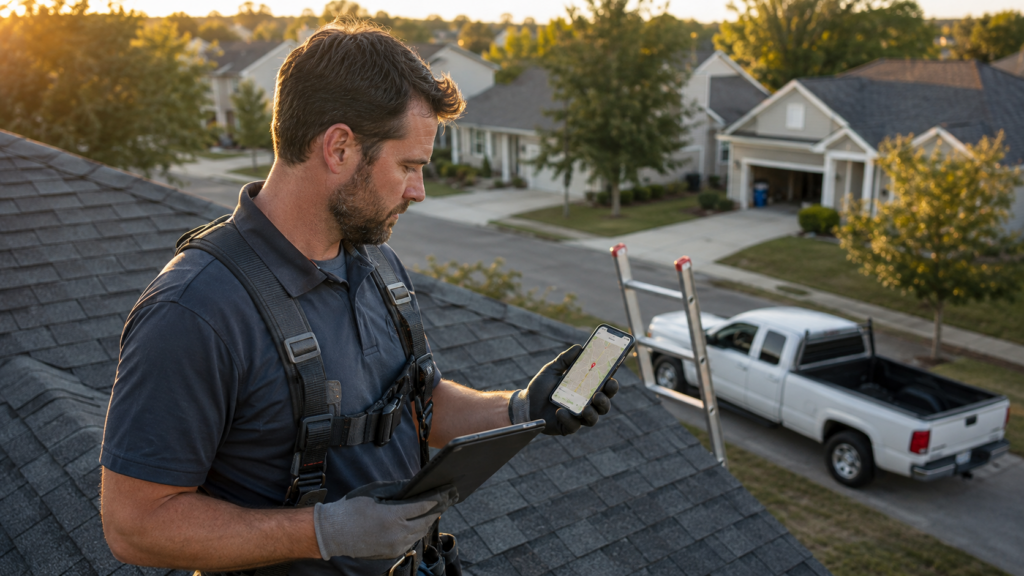
Roofing companies still ask me if Google Business Profile is just an online listing. It used to be. It isn’t anymore. I’ll tell a client flat out that their GBP carries more weight in whether they get found than their actual website does. Working roofing and home service clients across the US and the Philippines, I see the two markets teach different lessons on this constantly. The ranking mechanics don’t change. Who you’re competing against and how homeowners actually behave, that does. I’ll point out those differences as we go.
Here’s the blunt version of why this matters: when someone’s roof is leaking during a storm, they are not browsing a directory. They’re typing “roofer near me” or “emergency roof repair” into their phone and clicking one of the first three results they see. If you’re not in that Local Pack, you don’t exist to that homeowner.
Why the Local Pack still runs local search, and what’s changed around it
The old stat everyone quotes is that 46% of Google searches carry local intent. That figure traces back to a Google presentation from 2018, and honestly it’s probably light. More recent consumer research from BrightLocal shows 84% of consumers searched for a local business in just the past three months, and 80% of US consumers search for a local business online every week. For emergency trades like roofing, that intent spikes even harder around storm season.
What’s actually changed since that 46% stat first made the rounds is what happens after the search. Google’s local pack now regularly appears alongside, or sometimes underneath, an AI-generated summary. BrightLocal and several other trackers have documented AI Overviews growing from roughly 6-8% of searches in early 2024 to a much larger share of local queries in 2026. I’d flag this as the biggest shift in local SEO in the last two years: Google’s AI Overviews now pull directly from your Google Business Profile data (your hours, your reviews, your services, your photos) to build that summary. A thin or outdated profile doesn’t just rank worse in the map pack anymore. It gets skipped entirely when Google writes the AI answer.
On top of that, BrightLocal’s 2026 Local Consumer Review Survey found that 45% of consumers now use AI tools like ChatGPT for local business recommendations, up from just 6% a year earlier. Google’s own share of “where people check reviews” dropped from 83% to 71% over the same period. That doesn’t mean Google stopped mattering. It means your reputation now has to be legible to AI systems reading your reviews and profile data, not just to a human scrolling Google Maps. In the SEO world people are calling this GEO, generative engine optimization. For a roofer, practically speaking, it means: keep your GBP complete, keep reviews fresh and detailed, and make sure your website has clear, specific service and location content an AI model can actually cite. Vague “quality roofing since 1995” copy gives an AI nothing to pull from.
How Google actually ranks you in the Local Pack
Three factors, unchanged in principle even as the algorithm around them gets more AI-driven:
Relevance. How well your profile and website match the search query. Distance. Physical proximity to the searcher. You can’t change this, so don’t waste time trying. Prominence. Your overall online authority: review volume, review quality, citations, backlinks, engagement.
BrightLocal’s local ranking factor surveys have consistently put review signals and GBP proximity/relevance signals near the top of what actually moves rankings, well above on-page keyword tricks. If you’re spending more time perfecting your business description than you are generating reviews, you’ve got your priorities backwards.
Setting up the profile correctly the first time
This part hasn’t changed much, but people still get it wrong constantly.
Claim and verify. Go to google.com/business, search for your company, claim it if it exists, create it if it doesn’t. Use your exact legal business name, nothing added, no keyword stuffing like “Dallas Roofing Contractor Best Roofers” tacked onto the name. Google has gotten more aggressive about suspending profiles for this, and I’ve personally seen client accounts get flagged for it in the last year.
Verification. Postcard is still the most common method for roofing contractors. Video verification has become more common too. Phone and email verification are occasionally offered for established, verified-elsewhere businesses.
Fill out every field. Address (real business address, not a PO box), local phone number, website, hours, and category. Incomplete profiles are penalized more heavily now that Google’s AI summary tool is grading profile completeness against category peers, which one of the analyses I read this year described as comparing your profile against “anonymised peers in the same primary category and region.” Thin profiles get less favorable AI summaries even with decent reviews.
Categories. Primary category: “Roofing contractor.” Secondary categories can include general contractor, gutter cleaning service, siding contractor. Don’t pile on categories that don’t fit. It confuses the relevance signal and, in my experience, it’s one of the more common reasons a profile gets flagged for review by Google.
The description and the fields Google’s AI actually reads
Write your business description like you’re briefing someone who’s never heard of you and needs specifics, not adjectives. Something like:
“[Company Name] has served [City] homeowners since [year]. We handle residential roof repair, full replacement, and emergency storm damage restoration on asphalt shingle, metal, and tile roofing. Licensed, insured, and available 24/7 for storm response. Free estimates.”
That’s specific enough for a human to trust and specific enough for an AI Overview to lift accurate facts from. Skip the “unlock the potential of your roof” style copy. Nobody, human or machine, needs that.
Business hours: if you do 24/7 emergency response, say so explicitly and keep seasonal storm-season hours updated.
Phone number: local number, consistent everywhere, formatted the same way across every listing and citation.
NAP consistency: your Name, Address, and Phone number need to match exactly across your website, GBP, and every directory you’re listed on. This is still one of the top three things I find broken when I audit a new roofing client’s online presence, US or Philippines side.
Photos and video: the underused lever
Most roofing companies upload a logo, maybe a truck photo, and stop. That’s a mistake. Google Business Profile Insights consistently show profiles with active, recent photo uploads getting more views and more actions than static ones.
What actually works:
- Real job photos, not stock images. Before/after shots of actual roofs you’ve worked on, with the customer’s permission
- Team on the roof, in gear, mid-job. This builds more trust than a posed team photo in front of the office
- Descriptive file names before upload, like “metal-roof-replacement-cebu-city.jpg” or “asphalt-shingle-repair-dallas-tx.jpg.” It’s a small signal but it costs nothing to do right
- Upload weekly if you can manage it. Monthly at minimum. Google’s system explicitly treats fresh photo uploads as a freshness signal now, and stale profiles are one of the things getting dinged in the AI-summary era
If you’re a roofer in the Philippines reading this: video content matters more here than it typically does for our US clients. A lot of PH homeowners researching roofing repair, especially after typhoon season, are checking TikTok and Facebook alongside Google before they call anyone. Cross-posting job site video to GBP and to social isn’t optional here the way it might be for a US client in a smaller market. I go into more depth on what photo categories actually convert in Google Business Profile photos that convert: what contractors should showcase.
Google Posts: an underrated lever for rankings, Ask Maps, and AI citations
I want to push back on something I see repeated in a lot of older SEO guides, that Google Posts are purely a cosmetic feature with zero ranking value. That’s outdated. In my experience running these for roofing clients, Posts do more than just sit on the profile:
- They help the specific service page they link to. A Post that links to your “Emergency Roof Repair in [City]” page sends a fresh engagement and relevance signal tied to that URL, not just your homepage. I’ve watched service pages move up faster when they’re getting regular Post traffic pointed at them versus pages that never get linked from anywhere on the profile.
- They feed Ask Maps. Google rolled out Ask Maps in March 2026, a Gemini-powered feature inside Google Maps that answers conversational, multi-condition questions like “roofer who can do emergency tarp work tonight” by pulling from your profile data, not just a keyword match. A profile with active, specific, recent Posts gives Gemini more current material to draw from when deciding whether to surface you in that kind of answer. A dormant profile with no Posts in six months is working with stale inputs.
- They help you get cited in AI search and LLM answers. The same freshness and specificity that helps with Ask Maps also feeds into how AI Overviews and tools like ChatGPT summarize and recommend local businesses. Vague, infrequent Posts give an AI model nothing concrete to lift. Specific ones (“completed a full tear-off and metal roof replacement in [neighborhood] this week”) give it something citable.
So my actual position: I wouldn’t call Posts a classic ranking factor the way review count or proximity are. But in 2026, ranking, Ask Maps visibility, and AI citation are increasingly the same fight, and Posts are one of the few free, easy levers that touches all three. Treat them as a real part of your strategy, not an afterthought.
A posting rhythm that works for roofing clients I manage:
- One educational post a week (roof maintenance tips, storm prep, material comparisons)
- One project showcase every couple weeks (real before/after)
- Weather or seasonal alerts as needed, these get real engagement during actual storm events
- Company news when it’s genuinely newsworthy (new certification, new crew lead, a completed large job)
Keep the post body around 150 to 300 characters for best performance, include a clear call to action button, and always attach a real photo. For more on turning finished jobs into posts that actually get engagement, see using GBP posts to showcase contractor projects and promotions.
Reviews: this is where the game is actually won or lost
If I had to tell a roofing client to spend 80% of their GBP effort on one thing, it’s this.
The numbers here have moved fast. BrightLocal’s 2026 Local Consumer Review Survey (published February 2026, 1,002 US adults) found:
- 97% of consumers read reviews before choosing a local business
- 31% will now only use a business rated 4.5 stars or higher, nearly double the 17% who said that just a year earlier
- 47% won’t even consider a business with fewer than 20 reviews
- Review recency matters more than it used to. Reviews from the past 90 days now carry meaningfully more weight in both local pack ranking and in what gets pulled into AI-generated answers
That last point is the one I’d really flag for roofers specifically. A profile with 150 reviews from three years ago and nothing recent reads as dormant to both Google’s algorithm and to an AI summary tool. A profile with 40 reviews, most from the last six months, reads as active and trustworthy, even with a lower total count. Recency beats stockpiling.
Getting reviews systematically. Don’t leave this to chance or to “we’ll ask if we remember.”
- Text or email the review link within 48 hours of job completion, while the new roof is still front of mind
- Keep the ask short. One sentence, one link, no essay
- For bigger jobs (full replacements, insurance claims), a phone follow-up plus the text link performs better than either alone
- Train your crew leads to ask in person at final walkthrough. This consistently outperforms email-only asks in my experience
Responding to reviews. Respond to positive reviews within 24 to 48 hours, using the customer’s name and a specific detail from the job (roof type, material, neighborhood). Respond to negative reviews fast, professionally, without getting defensive, and take the resolution offline. Slow or generic responses are increasingly read by consumers as a red flag, per that same 2026 BrightLocal data. This isn’t just etiquette anymore, it’s a visible trust signal to anyone reading before they call. I’ve laid out actual response frameworks in how to respond to negative reviews on your contractor Google Business Profile, including what not to say.
One thing I’d add for the Philippine market specifically: review culture here skews toward Facebook recommendations as much as Google reviews, sometimes more. If you’re only chasing Google reviews and ignoring your Facebook Page recommendations, you’re missing where a real share of PH homeowners are actually forming their opinion of you.
Local content that supports the profile
Your GBP doesn’t operate in isolation. Google’s local algorithm updates through 2026 have put more weight on hyper-local content on your actual website, meaning neighborhood-specific and city-specific service pages, not generic national copy. Businesses running the same boilerplate page reworded for five cities lost ground in this year’s core updates. The ones with genuinely distinct, locally specific content held or gained.
Practical version of this for a roofer:
- A real service page per city or service area you actually work in, with specifics: local building codes, common roofing materials in that climate, actual neighborhood names
- Seasonal content tied to your actual climate. Storm prep in spring for US clients in the Midwest and Gulf states, typhoon-season roof inspection content for PH clients from roughly June through November
- FAQ content baked into both your website and your GBP Q&A section: licensing, insurance, service area, emergency availability, financing if you offer it. I cover this in more detail in GBP Q&A section: answering the questions potential clients actually ask
This is also the content an AI Overview is most likely to pull from when someone searches “does [company] serve [neighborhood]” or “roofers that handle storm damage in [city].” Specific, well-structured local content is what gets cited. Generic copy gets ignored.
Tracking what’s actually working
Don’t just watch your Local Pack position and call it a day. Track:
- GBP Insights: views, search queries (branded vs non-branded), calls, direction requests, website clicks
- If your account has the newer reporting breakdown, check the split between classic map panel views and AI summary card views. A rising share of views coming through AI surfaces is a real 2026 metric worth watching, and if it’s near zero, that’s usually a sign your profile is too thin for Google’s AI to summarize confidently
- Call tracking numbers so you know what’s actually generating phone calls, not just profile views
- Review velocity month over month, not just total count
Free tools: GBP Insights itself, Google Search Console, Google Analytics with proper UTM tagging on any links you put in posts or your profile.
Paid tools I use with clients: BrightLocal for rank tracking and review monitoring, and a keyword/competitor tool like Semrush or Ahrefs for the broader picture. If you want the full breakdown of what to actually track and how often, I wrote about it in how to track and measure GBP performance for your contracting business.
Mistakes I still see constantly
- Wrong location targeting, whether that’s a service area set too broad, too narrow, or just not matching where the crews actually work. I go into this specifically for multi-city contractors in GBP service areas: how to target multiple cities as a contractor
- Treating the website and GBP as two separate projects instead of one local SEO strategy. They should be feeding each other, not running on parallel tracks. I break down where to actually put your effort first in local SEO: website vs Google Business Profile, where contractors should focus first
- Building pages around keywords instead of around what the searcher actually wants. A page built to rank for “roof repair Dallas” instead of one built to answer “what does emergency roof repair in Dallas actually involve and cost” is the difference between a page that ranks and disappears and one that ranks and converts
- Inconsistent NAP across the website, GBP, and directories, still one of the most common issues I find on a first audit
- Keyword-stuffed business names, which risks suspension now more than it did a few years ago
- Buying or incentivizing fake reviews. Google’s detection has gotten materially better, and the FTC’s rule on fake reviews and testimonials, in effect since 2024, adds real regulatory risk on top of the platform risk
- Letting the profile go quiet for months and then wondering why visibility dropped. In the AI Overview era, a stale profile isn’t just a missed opportunity, it can actively drop out of AI-generated answers
- Ignoring the AI Overview reality entirely and optimizing only for the old three-pack. That’s optimizing for half the picture in 2026
A realistic first 30 days
Week 1: Claim and verify, complete every field, fix NAP inconsistencies across your website and top directories, upload 15 to 20 real job photos.
Week 2: Publish your first few Google Posts, seed your Q&A section with the five questions customers actually ask, set up a systematic review-request process (text or email template, sent within 48 hours of job completion).
Week 3: Respond to every existing review, old and new. Train your crew to ask for reviews in person at project completion.
Week 4: Set up call tracking and UTM tracking, establish your baseline metrics, and build one or two genuinely local, specific service pages on your website rather than boilerplate.
After that it’s maintenance: photos and posts weekly if you can, reviews coming in consistently rather than in bursts, quarterly review of what’s working against what your competitors are doing.
Where I’d get outside help
I’m not going to pretend this is a five-minute task, because it isn’t, especially once you’re managing it alongside actually running roofing jobs. This is genuinely what we do at Be Visible Media, GBP optimization paired with the broader local SEO work, for roofing and other home service contractors on both sides of the Pacific. If you’d rather hand this off than DIY it while you’re also running crews and chasing storm season, that’s the conversation to have with us. If you want a starting point before that conversation, run through my own GBP audit checklist for contractors first and see how many boxes you’re actually checking.
But even if you never work with an agency, the fundamentals above will move you. Complete profile, real photos uploaded consistently, a genuine review generation system, local content that’s actually local, and an awareness that Google’s AI Overviews are now reading your profile as much as a human is. That’s what separates the roofers sitting in the Local Pack from the ones wondering why they can’t get found.
