
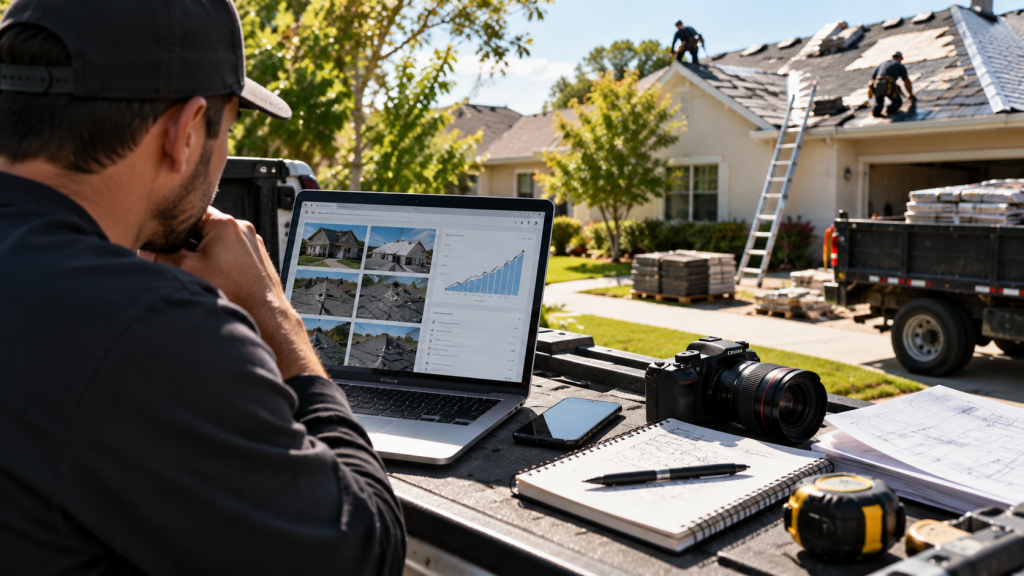
The harsh reality: Most roofing companies are invisible online despite spending thousands on websites and content. While your competitors struggle with generic “About Us” pages and stock photos of shingles, the 2% who crack the code are dominating local search results and converting visitors into high-value customers.
The Silent Killer: Why Roofing Content Fails
1. The Generic Trap
Most roofing websites read like carbon copies. They feature the same tired phrases: “quality workmanship,” “family-owned,” and “fully licensed and insured.” This generic approach creates three fatal problems:
Search engines can’t differentiate your content from the hundreds of identical pages in your market. Google’s ranking systems, including the helpful content signals now built into its core updates, reward original, people-first content that shows real experience. In 2026 there is a second version of this trap: copy-pasted or lightly edited AI-generated articles that say what every other roofer’s page already says. Search engines and AI answer tools can easily ignore them. When your “Services” page mirrors every other roofer’s page, you’re essentially invisible to search engines.
Potential customers bounce immediately because they can’t identify what makes you different. In a commodity-driven industry like roofing, differentiation through content becomes your competitive advantage.
You’re competing on price alone when prospects can’t distinguish between contractors. Without compelling content that demonstrates expertise and builds trust, homeowners default to choosing the lowest bidder.
2. The Local Search Blindness
Roofing is inherently local, yet most companies ignore local SEO fundamentals. They create content for “roofing services” instead of “roof repair in [city name]” or “storm damage restoration near [neighborhood].”
This oversight is costly because local searches are high-intent. Homeowners searching for a roofer nearby are usually ready to call or request an inspection quickly. When you miss local search opportunities, you’re handing qualified leads directly to competitors who understand geographic targeting.
3. The Technical Knowledge Gap
Many roofing companies either oversimplify their content (treating homeowners like they know nothing) or overcomplicate it (drowning prospects in technical jargon). Both approaches fail to build the trust necessary for high-ticket sales.
Homeowners researching roofing need enough information to feel confident in their decision without feeling overwhelmed. The sweet spot lies in demonstrating expertise while remaining accessible.
The High-Traffic Content Formula That Works
1. Hyperlocal Problem-Solution Content
Instead of generic service pages, create content that addresses specific local issues:
“Why [Your City] Homes Need Impact-Resistant Shingles: A 2026 Analysis” tends to perform far better than “Residential Roofing Services.” This approach works because it:
- Targets location-specific search terms
- Addresses real homeowner concerns
- Positions you as the local expert
- Creates urgency around current conditions
Geographic specificity multiplies your relevance. Content about “hail damage patterns in North Texas” will typically outperform generic hail damage content because it speaks directly to your target audience’s experience.
2. The Before/During/After Documentation Strategy
Visual storytelling transforms abstract services into tangible results. Document your projects with:
Before photos that show the problem clearly, helping homeowners identify similar issues on their own properties. These images create immediate relevance and urgency.
Process documentation that builds trust by showing your systematic approach. Time-lapse videos of tear-offs, material delivery, and installation demonstrate professionalism and attention to detail.
After photos that showcase transformation, but go beyond simple beauty shots. Include close-ups of flashing work, gutter integration, and detail work that highlights craftsmanship.
This strategy works because homeowners can envision their own transformation while gaining confidence in your capabilities.
3. Seasonal Urgency Content
Roofing demand fluctuates dramatically with weather patterns and seasons. Smart content marketing anticipates these cycles:
Spring content focuses on winter damage assessment and preparation for storm season. Topics like “5 Signs Winter Damaged Your Roof” capture homeowners emerging from cold months and assessing their properties.
Summer content emphasizes efficiency and preparation: “How to Schedule Roofing Work During Peak Season” or “What Summer Heat Does to Different Roofing Materials.”
Fall content drives urgency around winter preparation: “Why October is Your Last Chance for Roof Repairs” creates time-sensitive motivation.
Winter content addresses emergency situations and planning: “Emergency Roof Repair: What to Do Before Help Arrives” captures high-intent traffic when people face immediate problems.
4. The Authority-Building Trifecta
Establish dominance in your market through three content pillars:
Educational content that solves problems before they become emergencies. “How to Spot Roof Problems from Your Driveway” positions you as helpful rather than pushy while capturing early-stage prospects.
Industry insight content that demonstrates deep knowledge: “Why Insurance Companies Prefer Certain Roofing Materials” shows you understand the business side of roofing decisions.
Local community content that builds relationships: “Supporting [Local High School] Football Team Through Our Roof Sponsorship Program” creates emotional connections beyond transactional relationships.
Winning in the Age of AI Search (2026 and Beyond)
Search no longer ends with ten blue links. Google’s AI Overviews and AI Mode now answer many questions directly, and more homeowners ask ChatGPT, Gemini or Perplexity before they ever visit a website. A SparkToro study published in June 2026 found that about 68% of U.S. Google searches ended without a click in early 2026, up from roughly 60% in 2024, and that click-through rates fall by nearly 60% when an AI Overview appears.
For roofers, the impact is uneven. Urgent and “near me” searches such as roof repair, storm damage and roof replacement quotes are still dominated by the Google Maps local pack and Business Profiles. The searches taking the biggest hit are informational ones like “how long does a shingle roof last” or “how much does a roof cost,” because AI now summarizes the generic answer. That makes the specific, local content described in this guide more important, not less. AI tools tend to cite pages that are detailed, local and clearly written by someone who actually does the work.
To stay visible in both traditional and AI-driven results:
- Build pages around specific problems (hail damage, flashing leaks, ice dams, insurance claims) with local detail, cost context and photos from your own jobs
- Put the answer first: give a short, direct answer near the top of the page, then the detail
- Show real experience: named authors or crew leads, license numbers, project photos and warranty details
- Keep your business data consistent: identical name, address, phone number and service categories across your website, Google Business Profile and major directories
- Earn detailed reviews that mention the service and the city, since both Google and AI tools draw on review text, not just star ratings
- Build your brand beyond your website: local press, community sponsorships and trusted directory listings all reinforce who you are
Don’t abandon traditional SEO to chase “AI optimization.” The same fundamentals of helpful content, strong local signals and a clean technical setup drive visibility in both.
The Technical SEO Foundation
1. Page Speed Optimization
Roofing websites notoriously load slowly due to high-resolution project photos. This kills both search rankings and user experience. Optimize by:
- Compressing images without losing quality
- Using modern image formats (WebP, AVIF)
- Implementing lazy loading for photo galleries
- Minimizing plugin bloat
Page speed directly impacts conversion rates. Homeowners with a leaking roof are often calling several contractors at once, so a slow site loses them fast. Speed is also part of Google’s Core Web Vitals. On mobile, aim for Largest Contentful Paint under 2.5 seconds, Interaction to Next Paint (which replaced First Input Delay in 2024) under 200 milliseconds, and Cumulative Layout Shift under 0.1.
2. Mobile-First Design
Most roofing searches happen on mobile devices (about two-thirds of all Google searches are mobile), often during or immediately after weather events when homeowners discover problems. Your mobile experience must be flawless:
- Click-to-call buttons prominently displayed
- Forms optimized for mobile completion
- Image galleries that work smoothly on touch screens
- Fast-loading emergency contact information
3. Local Schema Markup
Technical SEO for roofing companies requires specific schema markup that most miss:
- LocalBusiness schema (use the more specific RoofingContractor type) with accurate name, address and phone data
- Service and areaServed markup for each city or county you cover
- Review and rating markup used carefully: Google ignores self-serving reviews (a business marking up reviews about itself) for star rich results, so don’t count on it to add stars to your listing
- Opening hours markup that clearly shows 24/7 emergency availability, if you offer it
A note on FAQ schema: Google has restricted FAQ rich results since 2023 and, according to 2026 industry reports, has now dropped them entirely. FAQPage markup is harmless, but don’t expect the expandable snippet in search results. Keep writing FAQ sections anyway because they help readers and AI answer tools.
Content That Converts: Beyond Traffic
1. Trust-Building Elements
High-ticket services like roofing require extensive trust-building. Effective content includes:
Licensing and certification displays prominently featured, not buried in footers. Create dedicated pages explaining what each certification means for homeowners.
Insurance claim assistance content that demonstrates your advocacy role. “How We Fight Insurance Companies for Our Customers” addresses a major homeowner pain point.
Warranty explanations that go beyond legal requirements to show genuine commitment. “What Our 20-Year Warranty Really Means” builds confidence in your long-term relationship.
2. Social Proof Integration
Testimonials work best when integrated contextually rather than isolated on dedicated pages:
- Include customer quotes within service descriptions
- Feature project testimonials alongside before/after photos
- Display video testimonials on high-traffic landing pages
- Showcase social media mentions and community involvement
- Encourage Google reviews that name the service and the city, because review text now feeds both local rankings and AI answers
3. Clear Next Steps
Every piece of content should guide readers toward action:
Emergency situations require immediate contact options with clear availability messaging: “24/7 Emergency Response – Call Now for Immediate Assessment.”
Planning situations need consultation scheduling with value propositions: “Free Roof Inspection Includes Written Assessment and Maintenance Recommendations.”
Educational content should transition to relationship building: “Download Our Homeowner’s Roof Care Guide” captures leads while providing value.
Measuring Success: Metrics That Matter
1. Local Search Visibility
Track rankings for location-specific terms rather than generic keywords. “Roof repair in [your city]” matters more than “roof repair” for most roofing companies.
Monitor your Google Business Profile performance data (formerly Google My Business Insights), including:
- Search queries leading to your listing
- Photo views and engagement
- Direction requests and phone calls
- Review acquisition rate
Google retired the public Q&A section on Business Profiles between late 2025 and early 2026 and is replacing it with Gemini-powered “Ask Maps” answers that draw on your profile, website and reviews. Because you can no longer pre-write those answers, a complete profile matters more: every service listed, the right categories, fresh photos, recent reviews and clear website content.
Also check whether AI tools mention you. Every month, search your top customer questions in Google (AI Overviews and AI Mode), ChatGPT and Perplexity, and note whether your company or pages are cited. Since AI answers reduce clicks, track branded searches, calls and direction requests alongside website visits.
2. Lead Quality Metrics
Traffic volume means nothing without quality leads. Monitor:
Lead source attribution (use call tracking and form-source tracking, since many roofing leads arrive by phone) to identify which content generates the best prospects. Educational content often produces higher-quality leads than promotional content.
Lead-to-customer conversion rates by content type. This reveals which topics attract ready-to-buy prospects versus tire-kickers.
Average project value by lead source. Some content attracts premium customers while other content draws price shoppers.
3. Seasonal Performance Patterns
Roofing content performance varies dramatically by season. Track:
- Content engagement during different weather patterns
- Lead generation spikes following storm events
- Seasonal keyword performance variations
- Emergency content activation rates
Implementation Strategy: Your 90-Day Action Plan
Month 1: Foundation Building
Week 1-2: Audit existing content and identify gaps in local relevance. Most roofing companies discover their content could apply to any city in America.
Week 3-4: Create location-specific landing pages for each service area with unique, locally-relevant content addressing specific regional concerns.
Month 2: Content Creation
Week 5-6: Develop seasonal content calendar aligned with local weather patterns and roofing cycles. Plan content themes around storm seasons, maintenance periods, and decision-making timeframes.
Week 7-8: Begin creating problem-solution content addressing the most common local roofing issues. Use customer service logs and frequently asked questions as content inspiration.
Month 3: Optimization and Expansion
Week 9-10: Implement technical SEO improvements focusing on mobile experience, Core Web Vitals, schema markup and a fully completed Google Business Profile. Most roofing companies see immediate improvements from basic technical fixes.
Week 11-12: Launch content promotion strategy including social media distribution, email marketing integration, local community engagement, a steady review-request process, and your first check of how AI search tools describe your company.
Looking Ahead to 2027
Nobody can predict Google’s next move, but the direction is consistent: more AI-generated answers, more of the search journey happening inside Google Maps and AI assistants, and more weight on proof that a real business does real work. Roofing companies should plan for:
- Fewer clicks, higher intent: expect less informational traffic and measure success in calls, quotes and booked inspections, not sessions alone
- Maps and AI assistants as the front door: your Business Profile, reviews and photos will matter as much as your website
- Original proof over generic copy: project photos, named crews, pricing context and local case studies are hard to copy and are what get cited
- Ongoing algorithm changes: Google ran a broad core update in March 2026 and usually runs a few each year, so build on durable fundamentals instead of tactics that chase a single update
- Brand demand: people searching for your company name are the strongest sign your content and reputation are working, so keep investing in reviews, referrals and community presence
For a deeper look at what generates roofing leads right now, see our guide to Roofing SEO in 2026.
The Competitive Advantage
While 98% of roofing companies struggle with invisible content, implementing these strategies creates sustainable competitive advantages:
Market positioning as the local roofing authority rather than just another contractor. Educational content builds expertise perception that justifies premium pricing.
Lead generation consistency that reduces dependence on referrals and word-of-mouth alone. Consistent content marketing creates predictable lead flow regardless of seasonal fluctuations.
Customer education that shortens sales cycles by pre-qualifying prospects. Well-informed customers make decisions faster and question pricing less frequently.
The roofing companies dominating local markets aren’t necessarily the largest or oldest—they’re the ones who understand that content marketing is relationship marketing at scale. Every piece of content is an opportunity to demonstrate expertise, build trust, and guide prospects toward choosing your company over competitors.
The question isn’t whether content marketing works for roofing companies—it’s whether you’ll join the 2% who do it effectively or remain invisible among the 98% who don’t.
Most potential roofing customers don’t realize the importance of maintaining or choosing the right roof for their homes or businesses. This is why roofing companies should expand their marketing efforts through SEO. Consider partnering with an SEO agency like Cebu-based Be Visible Media, which specializes in helping roofing and renovation businesses.
By working with SEO experts like Be Visible Media, you’ll receive strategies specifically designed for roofing companies. They provide targeted keywords, strategic content planning, content selection, and specialized knowledge in roofing business SEO—exactly what companies need to ensure their online presence drives positive conversions. It’s time to maximize your online presence with a trusted SEO expert today!
